Localization
Coworkee.Localization keeps languages and translations in the database and ships the texts of every module as embedded JSON.
[DependsOn(typeof(CoworkeeLocalizationModule))]
public sealed class MyAppDatabaseModule : CoworkeeModule
{
    public override void ConfigureServices(ModuleServiceContext context) =>
        context.Services.AddSingleton<ILocalizationResourceContributor, MyAppTexts>();
}

internal sealed class MyAppTexts : ILocalizationResourceContributor
{
    public void Define(LocalizationResourceContext context) => context.AddEmbeddedJson(typeof(MyAppTexts).Assembly);
}
Keys are the English texts. A module embeds Localization/{culture}.json:
{
  "Brands": "Marken",
  "Delete {0}? This cannot be undone.": "{0} löschen? Das lässt sich nicht rückgängig machen."
}
Initial languages
Without configuration an installation offers English plus every culture a module ships texts for (today en and de), English as default. LocalizationOptions (section Coworkee:Localization) narrow that down; setup stores exactly these languages, after that administrators change them on the Languages page.
{
  "Coworkee": {
    "Localization": { "Languages": [ "en", "de" ], "DefaultLanguage": "de" }
  }
}
The host does not start with an unknown culture or a default that is not among the languages. coworkee new --languages en,de --default-language de writes the same values into a new app.
In the client
CoworkeeLocalizer translates in pages and components; missing keys fall back to the key and are reported to the server, where they show up under Translations.
@inject CoworkeeLocalizer L
<MudButton>@L["Save"]</MudButton>
<MudText>@L["Delete {0}? This cannot be undone.", brand.Name]</MudText>
The user picks the language in the app bar. MudBlazor's own texts (pager, filters, dialogs) are translated as well. Set the culture before the first render:
var host = builder.Build();
await host.Services.InitializeCoworkeeClientAsync();
await host.RunAsync();
Administration
- Languages (
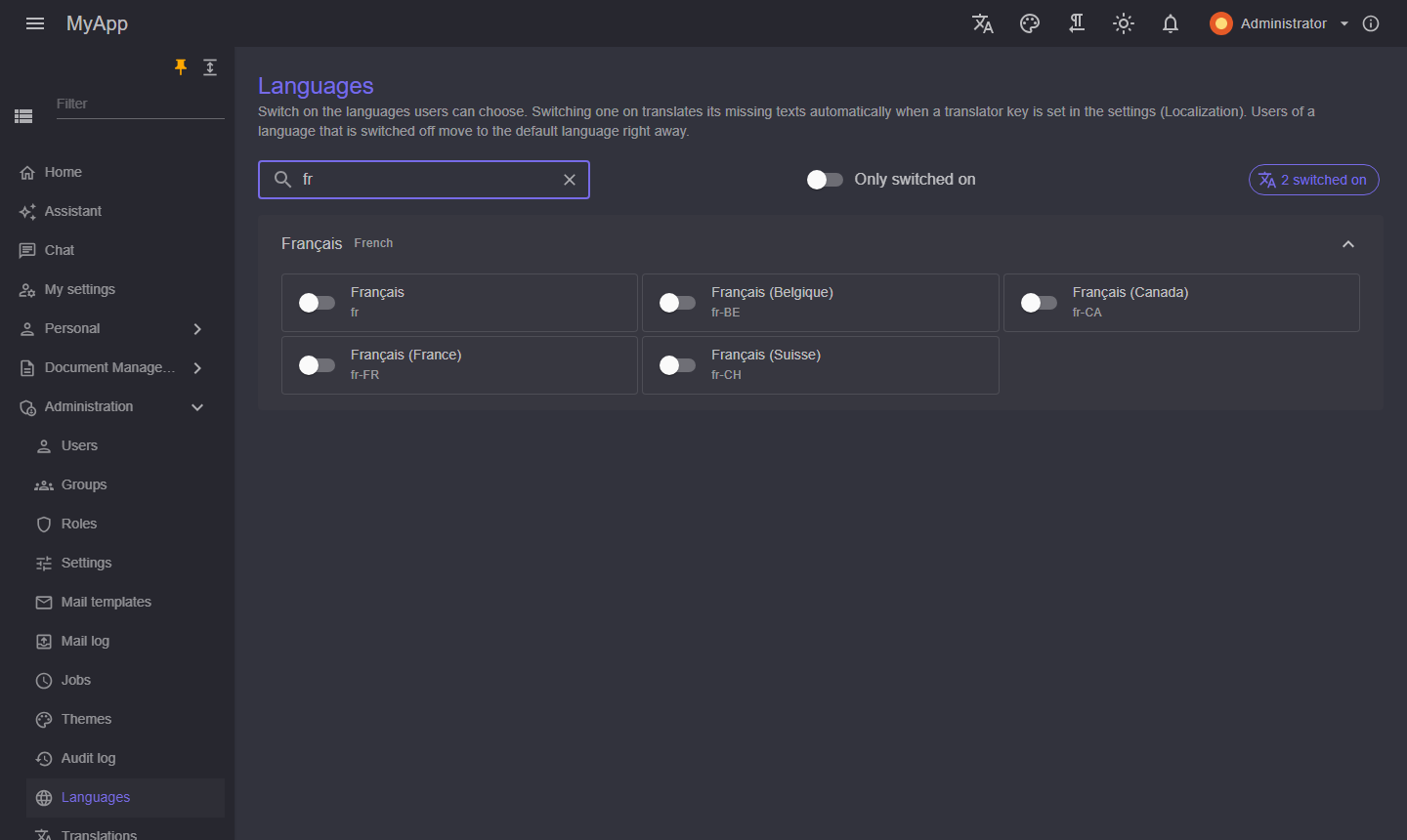
/admin/languages): every culture, grouped by language, with a switch. Switching one on translates the texts it lacks with the Azure AI Translator whenLocalization.TranslatorKey(andLocalization.TranslatorRegion) are set in the settings; a button translates what is still missing later. The star marks the default language, which cannot be switched off.
 - Translations (
/admin/translations): every key with the module text and the edited text per language. Edits win over the module texts.
Both need Localization.Manage.
Every change reaches all clients at once (global:localization realtime topic): they reload their texts, and users whose language was switched off move to the default language with a short notice.